
Last updated: November 4, 2026. By Turtle
TL;DR:
- The best DeFi incentive platforms in 2026 are Turtle Streams, Merkl, Metrom, Fuul and Brevis Incentra. Each tracks who holds or deposits into a position and pays rewards in tokens or points.
- The catch is the fee model. Merkl and Brevis Incentra take 3% from the budget, Turtle adds 1.5% on top, and Metrom and Fuul publish no fee rate in their docs.
- Compare them on the position you incentivize, the chains you pay out on, the controls you need (vesting, gap-fill, eligibility, attribution) and the full cost to deliver your budget to users.
- On an illustrative $100,000 campaign, users receive $100,000 on Turtle Streams for $101,500 sent, and $97,000 on Merkl for $100,000 sent.
- Before you commit, ask each vendor the same four questions about fees, payout chains, screening and post-launch changes, and get the answers in writing.

An incentive campaign is a budget commitment. Once it is funded, the rate model, eligibility rules and payout chain decide who earns and how much of the budget reaches depositors.
To build this list, we gave every platform the same fields and filled them only from each vendor's own docs, read on November 4, 2026. Turtle Streams is Turtle's product and sits first; the other four are ranked on the same criteria. New to the topic? Start with our guide to DeFi incentive infrastructure.
How do the platforms compare?
Turtle Streams, Merkl, Metrom, Fuul and Brevis Incentra are the best DeFi incentive platforms in 2026. Here is the same data for all five.
| Platform | Best for | Reward types | Payout chains | Published fee |
|---|---|---|---|---|
| Turtle Streams | Vaults and pools that need vesting, a target APR or partner attribution | TVL-Based, Deposit-Based (vesting tiers), Airdrop; tokens or points | Ethereum, Base, Avalanche, BSC | 1.5% creation fee on funded token streams, added on top; points streams free |
| Merkl | The widest chain and campaign coverage | 200+ campaign types: liquidity, lending, holding, vaults, airdrops; points indexing | Dozens of chains; can track on one chain and pay on another | 3% of distributed incentives, taken from the budget, falling to 1.5% above $5M |
| Metrom | AMM pools paid against a TVL goal or price range | Pool liquidity, lending, token holding; KPI and range-based; tokens or points | 16 networks listed across supported protocols | Not published |
| Fuul | Liquidity rewards combined with referrals, affiliates or trading rewards | Fixed, variable, pool distribution, leaderboard; tokens or points | EVM chains (Arbitrum, Base, Optimism, HyperEVM and more), Solana, Fogo, Stellar | Not published |
| Brevis Incentra | Concentrated liquidity, lending and holding campaigns with ZK-verified rewards | Token holding, concentrated liquidity, lend and borrow | Ethereum, Arbitrum, OP, Linea, BNB Chain, Base, World Chain, TAC, UNITS Network | 3% of total rewards, taken from the budget |
How did we rank them?
We ranked by fit for paying LPs and vault depositors. A platform scored higher when its docs show direct payment to depositors, controls that protect the budget, a published fee and a clear claim flow.
Seven capabilities separate a strong incentive platform:
- Eligibility controls: allow and block lists, minimum holdings, and rules on which deposit routes count.
- Gap-fill or target rates: paying only the difference between native yield and a target, so spend falls when the vault performs.
- Vesting and retention: rewards that become claimable at cliffs, so depositors who stay earn the most.
- Attribution: crediting the partner or distributor that brought a deposit.
- Sanctions screening: excluding flagged wallets, ideally by default.
- Claim cadence: how often rewards become claimable, and whether claims can be made for users.
- Fee transparency: a published rate, and whether it comes out of the budget or sits on top.
Which DeFi incentive platform ranks first?
1. Turtle Streams
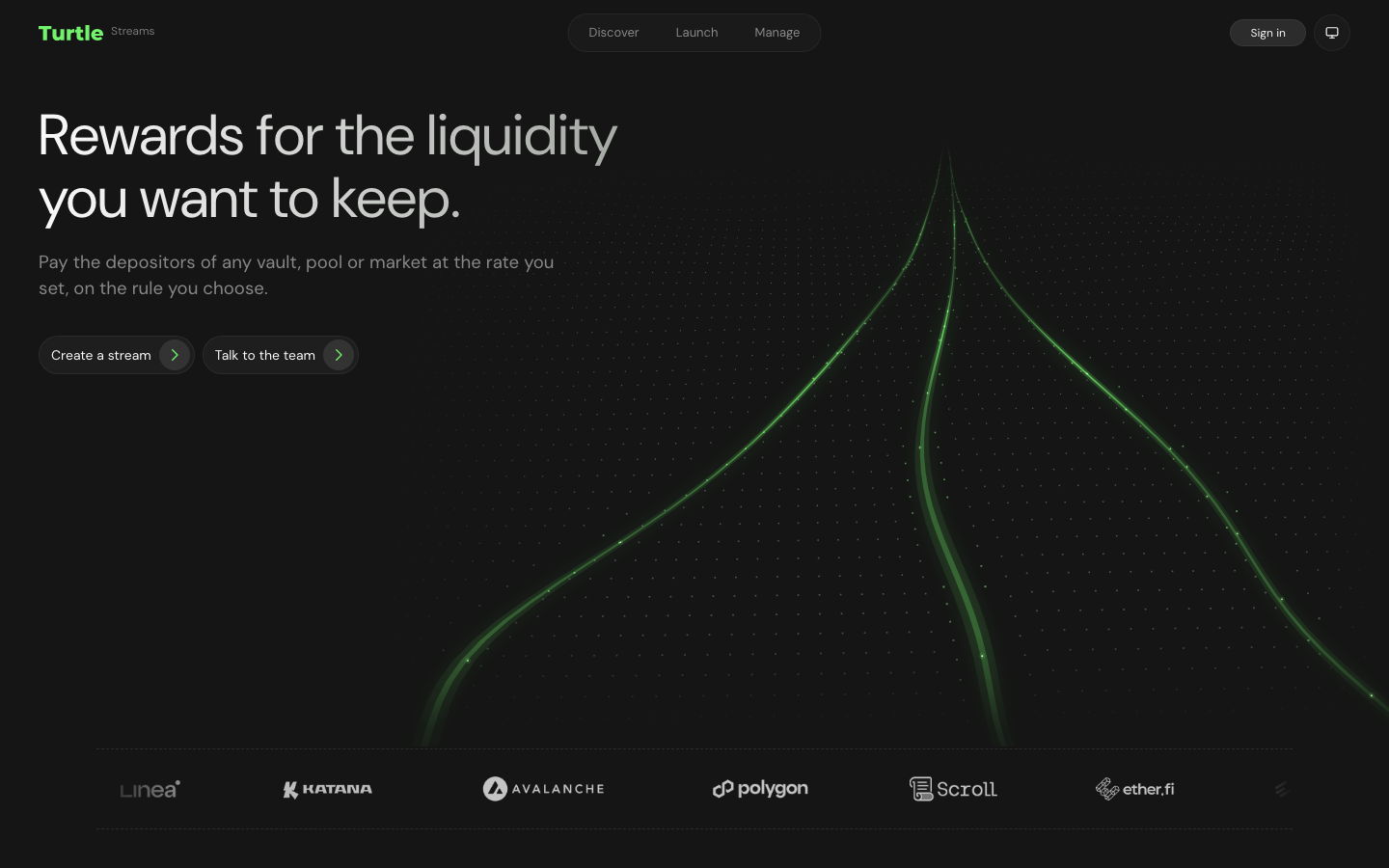
Turtle Streams, streams.turtle.xyz, November 2026.
Turtle Streams is a self-serve tool that pays tokens or points to LPs for the TVL they hold or the deposits they commit.
- Best for: vault curators and protocols on Ethereum, Base, Avalanche or BSC that want deposit vesting, a target APR or rewards scoped to partner deposits.
- Background: each stream is a separate non-custodial contract that holds its own funds, audited in January 2026 (Streams overview, audit reports).
- Reward types and controls: TVL-Based, Deposit-Based or Airdrop, paid in tokens or points. Rates: Fixed Rate (tokens per $1,000 of TVL per day), Fixed APR, Daily Budget, Target APR or Reference APR. Target APR pays only the gap between your target and the vault's trailing native APY (7 days to 6 months), and nothing when the vault meets it. Deposit-Based streams set duration tiers with a rate each; withdrawing before a cliff forfeits that tier's unvested rewards (choosing a reward model). Eligibility can be scoped to All Deposits, Turtle Only or Select Distributors, each distributor identified by its Builder Code (Distributor Metrics). Whitelists and blacklists are available, and wallets flagged by the Chainalysis Sanctions Oracle are excluded by default. Reward Forwarding passes rewards earned by a vault address through to its depositors.
- Chains: payouts on Ethereum, Base, Avalanche and BSC; the tracked target token can sit on a broader set of chains (create-stream reference).
- Claims: the first snapshot lands within about 12 hours, and a new Merkle root is committed roughly every 12 hours. LPs claim on Turtle, in your own front end, or through delegated auto-claim (claiming rewards).
- Pricing: a 1.5% creation fee on the funded reward amount, paid on top in the reward token. Points streams have no fee, and Turtle Pro organizations pay 0% (before you start).
- Worth knowing: budget and duration are fixed at launch, and every stream must distribute at least $33.33 per day. Ask whether your payout chain is live, and size the budget before you create the stream.
See every setting in the Streams docs overview.
What do the other four offer?
Merkl, Metrom, Fuul and Brevis Incentra each fit a different job. Prices appear only where published, and "Worth knowing" is the question we would ask that vendor first.
We also considered Royco, Absinthe, Hidden Hand, Galxe, Layer3, Gauntlet and Stake DAO Votemarket, and left them out. Royco's docs now describe a risk and liquidity tranching protocol (Royco overview). Absinthe's site says the company is winding down. Hidden Hand's docs overview was last updated two years ago. Galxe and Layer3 run quest campaigns, and their public docs do not let us fill these fields for LP and vault rewards. Stake DAO Votemarket pays veToken holders who vote for a gauge, so LPs earn only through the emissions those votes direct. Gauntlet is a service firm that designs incentives on top of a distribution tool (Gauntlet).
2. Merkl
Merkl homepage, November 2026.
- Best for: teams that need broad chain and venue coverage or complex eligibility logic.
- Background: Merkl describes 200+ campaign types across dozens of chains, including cross-chain and retroactive campaigns.
- Reward types and controls: liquidity, lending and borrowing, token holding, vaults and airdrops. Eligibility can use whitelists, blacklists, token snapshots, the Chainalysis Sanctions Oracle, World ID and duration-gated holding. Target Total APR campaigns top up any ERC-4626 vault to a target rate. Points are indexing only.
- Chains: dozens of chains.
- Claims: rewards update about every 8 hours (4 to 12, by chain), followed by a 1-2 hour dispute window. Autoclaim is a paid add-on.
- Pricing: 3% of distributed incentives, deducted from the budget, with volume tiers; airdrops 0.5% on top; points indexing $40 per week per point source.
- Worth knowing: Merkl Studio does not show every building block, and some setups go through a BD ticket or the API. Ask whether your setup is available in Studio.
3. Metrom
Metrom homepage, November 2026.
- Best for: AMM teams paying against a TVL goal or a price range.
- Background: a programmable incentives platform for liquidity, lending and token holding (Metrom docs).
- Reward types and controls: KPI campaigns scale rewards to how much of a TVL goal is reached: with a $10 million KPI and $5 million reached, 50% of the pool is paid and the rest can be recovered (KPI campaigns). Range-based campaigns pay liquidity inside a chosen range. Allow or block lists hold up to 20 addresses (address restrictions). Points campaigns cannot use KPI or range rules (points).
- Chains: 16 networks listed across DEXes, Liquity V2 platforms and Aave on Aptos (supported protocols).
- Claims: a claims page with a Claim all option for several reward tokens in one transaction (claim rewards).
- Pricing: no fee rate is published in the docs. Points campaigns pay a campaign fee in a token you choose.
- Worth knowing: ask for the fee rate in writing, and check that 20 list entries cover your exclusions.
4. Fuul
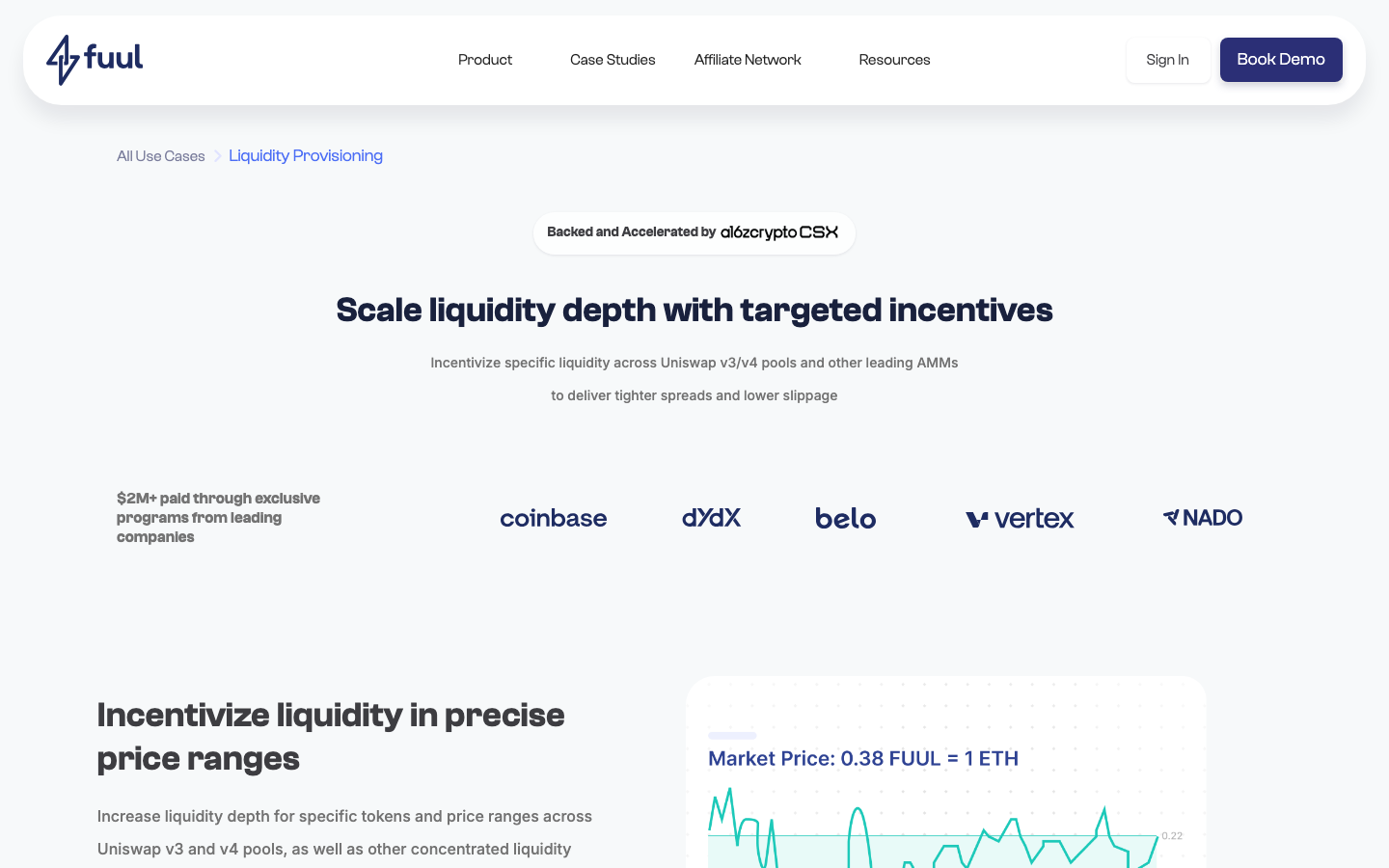
Fuul, liquidity provisioning page, November 2026.
- Best for: liquidity rewards combined with referrals, affiliates or trading rewards.
- Background: Fuul describes itself as incentives infrastructure for digital asset companies and fintech platforms, accelerated by a16z Crypto (CSX) (what is Fuul).
- Reward types and controls: tokens or points, paid as fixed rewards, variable rewards, pool distribution or leaderboard rewards, with tiers and multipliers (incentive payouts). Integrations cover concentrated and constant AMM pools, lending (Morpho, Compound), staking, token holders and Pendle (DeFi LP tutorial). Controls include sybil detection, payout caps, a blacklist and opt-in wallet screening (fraud prevention).
- Chains: budgets deploy on supported EVM chains (Arbitrum, Base, Optimism, HyperEVM and more), Solana, Fogo or Stellar. Each program has its own contract that the project administers (budgets and smart contracts).
- Claims: token rewards become signed claim checks that users redeem onchain. Projects can claim on users' behalf, or turn on Automated Claims on a set cadence with gas billed back (automated claims). Points are credited offchain with no claim.
- Pricing: not published in the docs or on the site.
- Worth knowing: reward tokens need whitelisting. Ask for the fee, and whether screening can be on from day one.
5. Brevis Incentra
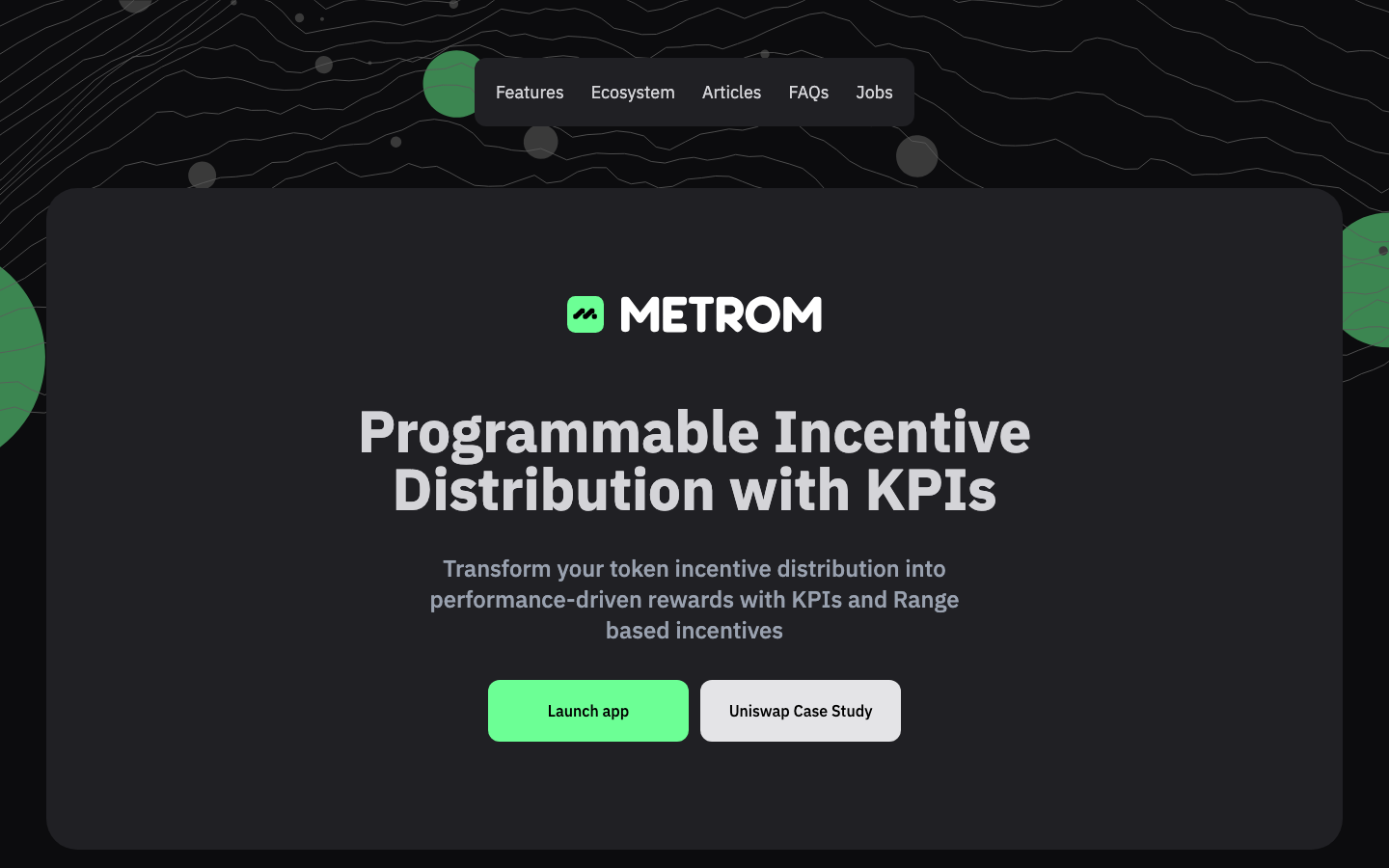
Brevis Incentra, Earn page, November 2026.
- Best for: concentrated liquidity, lending and token-holding campaigns that want rewards computed with ZK proofs.
- Background: Incentra is Brevis's incentive distribution platform. Rewards are calculated in ZK circuits and verified onchain, so users can check their own amounts (why use Incentra). Contract audit reports are public (audit reports).
- Reward types and controls: token holding (time-weighted average balance), concentrated liquidity (rewards in proportion to the fees each LP earns) and lend and borrow. Supported protocols are Uniswap v3, PancakeSwap v3, KoalaSwap and Euler (supported chains and protocols). Address-based access controls and reward forwarding through ALM contracts are built in.
- Chains: Ethereum, Arbitrum, OP, Linea, BNB Chain, Base, World Chain, TAC and UNITS Network. A campaign can track activity on one chain and pay rewards on another.
- Claims: rewards are attested every 4 hours, and the first update can take 4 to 12 hours (campaign rules). Users claim on the Incentra dashboard, up to 180 days after a campaign ends (user tutorials).
- Pricing: 3% of total rewards by default, taken from the reward pool (fee).
- Worth knowing: Brevis whitelists the campaign creator's address and every token before launch (getting started). Ask how long whitelisting takes.
How much do they charge?
Turtle Streams, Merkl and Brevis Incentra publish their fees. Metrom and Fuul do not publish a rate in their docs. Merkl and Brevis Incentra deduct their fee from the budget, and Turtle adds its 1.5% creation fee on top of the funded amount.
| Illustrative $100,000 campaign | Merkl (standard, first $1M) | Turtle Streams (token stream) |
|---|---|---|
| You send | $100,000 | $101,500 |
| Fee | $3,000 (deducted) | $1,500 (on top) |
| Paid to users | $97,000 | $100,000 |
| To pay users the full $100,000 | Send about $103,093 | Send $101,500 |
Merkl's rate falls with total volume distributed by your entity:
- 3% on the first $1M
- 2.25% between $1M and $2.5M
- 1.75% between $2.5M and $5M
- 1.5% above $5M
Merkl also offers a 25% discount for paying fees upfront on $500k or more, and subscription tiers. Brevis Incentra's default 3% works out the same as Merkl's first tier in this example. On Turtle, points streams have no fee, and Turtle Pro organizations pay 0%.
Which platform fits your use case?
Start from the position and the payout chain, then shortlist one or two platforms.
| Use case | Start with | Why |
|---|---|---|
| ERC-4626 vault on Ethereum, Base, Avalanche or BSC | Turtle Streams | Deposit vesting, Target APR and Reward Forwarding |
| Vault or market on another chain | Merkl | Dozens of chains; Target Total APR for any ERC-4626 vault |
| AMM pool paid against a TVL goal | Metrom | KPI campaigns pay in proportion to the goal reached |
| Concentrated liquidity in a price range | Metrom, Fuul | Range-based rewards; in-range active liquidity rewards |
| Rewards for partners who bring deposits | Turtle Streams, Fuul | Select Distributors by Builder Code; referrals and affiliates |
| Points before a token exists | Turtle Streams, Fuul | Free points streams; offchain points with no claim |
| Rewards that users can verify with ZK proofs | Brevis Incentra | Rewards computed in ZK circuits and verified onchain |
What should you ask before you choose?
Ask every vendor on your shortlist the same four questions.
- Is the fee taken from the budget or added on top, and what is the rate at my volume?
- Which chains can you pay out on today, and can you track a position on one chain and pay on another?
- How are sanctioned and sybil wallets kept out, and is screening on by default?
- What can I change after launch?
Red flags: a promised APR or APY for depositors, fee terms you cannot get in writing, contracts with no public audit, and no way to recover unspent budget.
How do you set up your first campaign?
A first campaign takes six decisions. Our guide on how to launch a liquidity incentive campaign walks through each one.
- Pick the position and the payout chain.
- Pick the reward type: TVL-Based, Deposit-Based, Airdrop or points.
- Set the rate: Fixed Rate, Daily Budget, Fixed APR or Target APR.
- Set eligibility: deposit routes, lists and screening.
- Size the budget as cost per $1,000 of TVL per day, using our cost-per-TVL benchmarks.
- Fund, launch and monitor, with the fee counted in. Our incentive campaign fees compared post covers every fee model.
How do you start a stream on Turtle?
Create, fund and launch a stream yourself at streams.turtle.xyz. Pick the vault or pool, choose a reward type and rate, set who can earn, and fund it. Points streams launch instantly with no funding. Your organization needs Client Portal approval and the stream-creation permission first.
FAQ
Which incentive platform is best for a vault?
For an ERC-4626 vault on Ethereum, Base, Avalanche or BSC, Turtle Streams covers the most vault-specific needs: deposit vesting with cliffs, Target APR gap-fill, and Reward Forwarding to the vault's depositors. Merkl also offers gap-fill for ERC-4626 vaults and fits a vault on a chain Streams does not pay out on.
How do fees compare?
Merkl charges 3% of distributed incentives, taken from the budget, falling to 1.5% above $5M distributed. Turtle Streams charges a 1.5% creation fee on top of a funded token stream, with no fee on points streams or for Turtle Pro. Brevis Incentra charges 3% of total rewards by default. Metrom and Fuul do not publish a fee rate in their docs.
Can I run a campaign without talking to sales?
Yes, after a one-time setup. On Turtle, you configure, fund and launch each stream yourself once your organization is approved in the Client Portal, has signed a master services agreement and has the stream-creation permission. Merkl Studio is self-serve once your reward token is whitelisted.
Can I run a points program on these platforms?
Yes, with different models. Turtle points streams are created instantly, with no funding, no creation fee and no onchain claim. Merkl indexes activity for your own points ledger at $40 per week per point source. Fuul credits points offchain with no claim, and Metrom offers points campaigns without KPI or range rules.
How long until depositors can claim rewards?
On Turtle Streams, the first snapshot lands within about 12 hours, and a new Merkle root is committed roughly every 12 hours after that. On Merkl, rewards become claimable at the first reward update, usually within 8 hours, and each update is followed by a 1-2 hour dispute window.